
 English
 Español
 Français
 Deutsch
 日本語
 한국어
 العربية
Pentera alternatives for AWS: validating attack paths without executing attacks
Key takeaways
- Pentera is an automated security validation platform. Its public materials describe emulating attacker techniques against internal networks, identities, and external attack surface, with a cloud module for AWS and Azure accounts since 2024.
- In the AWS control plane every attacker move is an API call decided by policy, so a path can be proven read-only by resolving the authorization for each step. That is how Pathbreak validates.
- Pathbreak ranks the proven paths by blast radius, names the change that breaks each one, and confirms the change afterwards, on a daily schedule, with nothing executed in the account.
- The two methods answer different questions and fit together: emulated attacks for the parts of an estate where that is the proof you need, and read-only authorization resolution for the AWS control plane every day.
- Neither replaces a manual AWS security assessment; both complement one.
Pentera is one of the best-known names in automated security validation. According to its public materials, the platform emulates the techniques an attacker would use against internal networks, identities, and the external attack surface, and reports which ones succeeded. In 2024 it added a cloud module that applies the same approach to AWS and Azure accounts, looking for identity compromise, role privilege escalation, lateral movement to platform services, and code execution. Teams searching for Pentera alternatives are usually asking one of two questions: is there another way to get emulated attacks, or is there a way to validate cloud exposures without executing anything in a production account. This post is about the second. Confirm the Pentera details with the vendor before deciding anything.
Two ways to produce proof
An emulated attack behaves like an attacker. It starts from a foothold, attempts to move, and the evidence is what it reached: a captured credential, a host it controls, a role it assumed. For networks, Active Directory, and endpoint estates that is the most direct form of proof available, and it is what platforms like Pentera are built to produce.
In the AWS control plane the proof can come from a different place. An attacker's moves are API calls, and whether each call succeeds is decided before anything runs, by the policy documents AWS evaluates together: the caller's identity policies, any permission boundary, the service control policies on the organizational unit, the trust or resource policy on the target, and the condition keys on each statement. Resolving those documents the way AWS would, for every step of a path, gives the same allow or deny the call would get. If every step resolves to allow, the path is proven, and nothing was created, invoked, or changed. The analysis vs validation post walks one chain through that process.
How Pathbreak validates
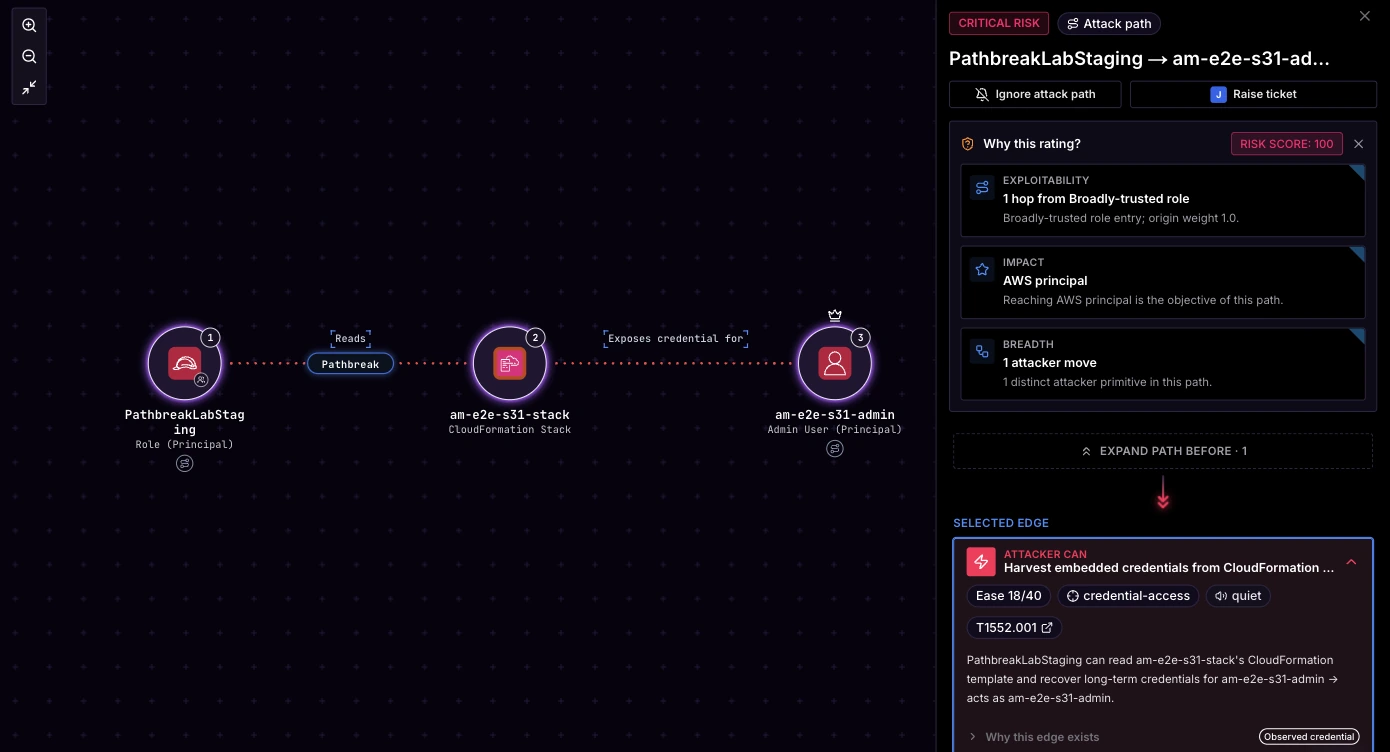
Pathbreak connects through a read-only cross-account role, builds the graph of principals, policies, trust edges, and resources, and reasons over it to produce candidate chains, including multi-hop and cross-account ones. It validates each chain by resolving the full authorization for every step and records the result as evidence. Proven paths are ranked by what they reach across accounts, each one comes with the specific change that breaks it, and after the change ships the path is re-evaluated and confirmed gone. Because the method is read-only, it runs daily against production with no change window. In the Pathbreak lab account, a single Deny on one role removed 3,893 of 4,087 proven paths, and two changes removed 80 percent of the risk.
Side by side
The table describes what each approach is built for, in its own terms.
| Dimension | Pentera | Pathbreak |
|---|---|---|
| Method | Emulates attacker techniques | Resolves the AWS authorization for every step of a path, read-only |
| Built for | Internal networks, identities, external attack surface, with a cloud module for AWS and Azure | The AWS control plane: IAM privilege escalation, cross-account trust, exposed credentials, public entry points |
| Evidence | What the emulated attacker reached | The authorization result for each hop, recorded per path |
| Cadence | On demand or scheduled, per the vendor | Daily, across every account |
| Output | Findings with the achieved impact and remediation guidance | Proven paths ranked by blast radius, the change that breaks each, and a confirmation after the change |
| Access needed | Per the vendor's deployment guide | Read-only cross-account role, nothing executed |
When emulated attacks are the right answer
If the estate you are worried about is on-premises, if Active Directory is the crown jewel, if you need proof that a phishing foothold on an endpoint leads somewhere, or if an auditor wants evidence that an attacker was emulated end to end, that is the tool to use. Pentera and its peers are built for it, and a cloud module on top makes sense when the cloud is one part of a broader estate.
When to add read-only validation for AWS
If AWS holds your sensitive data and privileged roles, if the number of accounts and roles is large enough that periodic testing cannot cover it, or if you want proof without a change window, add control-plane validation. The two approaches sit well together: emulated attacks for the parts of the estate where that is the proof you need, and read-only validation for the AWS control plane, every day. Both complement a manual AWS security assessment, and neither replaces one. Pricing is by AWS account band and is published, and the recorded walkthrough shows the validated path view on a real account.
Frequently asked questions
Is Pathbreak a Pentera alternative?
For validating attack paths in the AWS control plane, yes. Pathbreak proves each path by resolving the real authorization read-only, ranks proven paths by blast radius, and names the change that breaks each. For emulated attacks against networks, Active Directory, and endpoints, Pentera and similar platforms do something Pathbreak does not.
Does Pathbreak execute attacks in my AWS account?
No. In AWS every attacker move is an API call decided by policy documents, so Pathbreak resolves those documents for every step of a path and records the result. Nothing is created, invoked, or changed, which is why it can run daily against production.
Can I run Pathbreak alongside Pentera?
Yes. Teams use emulated attacks for the parts of the estate where that is the proof they need and Pathbreak for continuous validation of the AWS control plane. The outputs are different and both feed the same exposure management program.
Does either tool replace a manual AWS security assessment?
No. Automated validation covers what can be automated, continuously. A manual assessment covers application logic, business context, and the judgment of an experienced tester. Pathbreak is built to complement that work.
See the proven attack paths in your AWS accounts, with nothing executed, and the change that breaks each one.
Request a demo Watch the demo