
 English
 Español
 Français
 Deutsch
 日本語
 한국어
 العربية
Wiz alternatives for AWS attack paths: what a CNAPP answers and what Pathbreak adds
Key takeaways
- Wiz is a cloud-native application protection platform: the system of record for cloud inventory, vulnerabilities, misconfigurations, and multi-cloud posture, with attack path analysis built on its Security Graph.
- Prowler is the widely used open-source scanner. Its Attack Paths feature, added in version 5.17, lets you query a graph of your AWS IAM relationships with built-in and custom queries.
- Pathbreak is narrower by choice. It covers the AWS control plane, validates each attack path against the real authorization, ranks the proven paths by blast radius, hands back the change that breaks each one, and confirms the change afterwards.
- Most teams searching for a Wiz alternative want one of two things: the same breadth at a different price, or a validated answer to "which of these paths work." This post is about the second.
- Pathbreak runs alongside a CNAPP or in place of a standalone scanner. It complements a manual AWS security assessment and does not replace one.
Searches for Wiz alternatives come from two places. Some teams want the same breadth, a CNAPP that covers inventory, vulnerabilities, misconfigurations, secrets, containers, and code across several clouds, at a different price. Others have the breadth already and want a validated answer to a narrower question: of all the attack paths on the graph, which ones work against the authorization AWS evaluates, which fix removes the most, and did the fix hold. This post is for the second group. It describes what a CNAPP like Wiz is built for, what Prowler's Attack Paths feature does, and what Pathbreak adds. Vendor descriptions are drawn from each vendor's public materials; confirm the details with them before deciding anything.
What Wiz is built for
Wiz connects to cloud accounts without agents, builds an inventory of workloads, identities, configurations, and data, and places the findings on a graph that shows how they relate. Its attack path analysis searches that graph for chains where several lower-severity issues combine into a route to a critical asset, which Wiz calls toxic combinations, and ranks the chains by impact. Its public materials describe runtime signals from a sensor feeding the graph and findings traced back to code.
That is a strong system of record. If the question is "what do we have, where is it vulnerable, and how does it all connect" across AWS, Azure, Google Cloud, Kubernetes, and code, a CNAPP is the right tool and Wiz is a leading one.
What Prowler Attack Paths does
Prowler is the widely used open-source cloud scanner, and version 5.17 added an Attack Paths feature for AWS. During a scan it builds a graph of IAM principals, policies, trust relationships, and resources, then offers built-in queries, some based on Datadog's pathfinding.cloud research, plus custom read-only openCypher queries, with the results drawn as a graph. It is a good way to explore the IAM relationships in an account, and a real step forward for the open-source toolchain.
What Pathbreak adds
Pathbreak is built for one question in one cloud. It connects to AWS read-only, builds the graph, reasons over it to produce candidate chains including multi-hop and cross-account ones, then validates each chain end to end by resolving the authorization AWS would evaluate for every step: identity policies, permission boundaries, service control policies, trust and resource policies, and condition keys. Nothing is executed. Each proven path is ranked by what it reaches across accounts, so the first fix is the one that removes the most risk. Each path comes with the specific change that breaks it. After the change ships, the path is re-evaluated and the result is recorded, so the ticket closes on evidence.
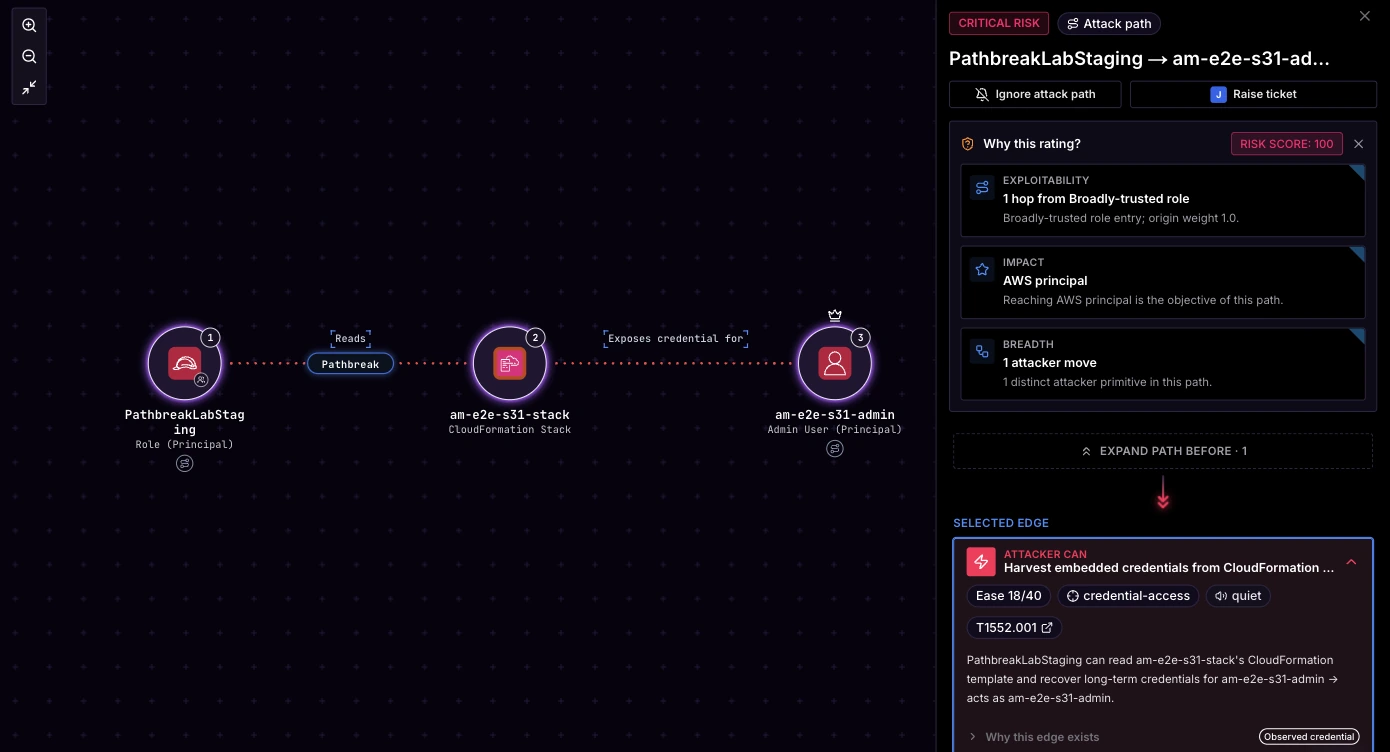
In the Pathbreak lab account, 4,942 candidate paths reduced to a list where a single Deny on one role removed 3,893 of 4,087 proven paths, and two changes removed 80 percent of the risk. The analysis vs validation post walks one chain from reachable to proven, and the recorded walkthrough shows the validated path view on a real account.
Side by side
The table describes what each tool is built for, in its own terms.
| Dimension | CNAPP (Wiz, Orca) | Scanner (Prowler) | Pathbreak |
|---|---|---|---|
| Built for | One inventory, vulnerability, and posture view across clouds, containers, and code | Open-source checks across providers, with graph queries over AWS IAM | Validated AWS attack paths, the fix, and the confirmation |
| Attack paths | Graph-based analysis of toxic combinations, ranked by impact | Built-in and custom openCypher queries over the scan graph | Candidate chains validated against the full AWS authorization, including cross-account |
| Output per path | The chain, its severity, and remediation guidance | The matching graph pattern | The authorization result for each hop, the blast radius, the change that breaks the path, and a confirmation after the change |
| Cloud coverage | AWS, Azure, Google Cloud, and more | AWS, Azure, Google Cloud, Kubernetes, and more | AWS today, Azure and Entra ID next |
| Exposure and compliance checks | Yes | Yes | Yes for AWS, hundreds of checks and 44 frameworks |
| Access needed | Read-only, optional sensor for runtime | Read-only | Read-only cross-account role, nothing executed |
When Wiz is the right answer
If you run more than one cloud and need one inventory, one vulnerability view, and one set of policies across them, keep the CNAPP. If your biggest gaps are container images, exposed secrets in code, or vulnerability management, the CNAPP is the right place for that work. Pathbreak does not try to be that platform.
When to add Pathbreak
If AWS is where your sensitive data and privileged roles are, and you want each attack path proven against the real authorization, ranked by what it reaches, and confirmed gone after the fix, add Pathbreak. Teams run it alongside Wiz, and teams without a CNAPP use it in place of a standalone scanner, since it carries the exposure checks and compliance coverage too. In both cases it complements a manual AWS security assessment and does not replace one. Pricing is by AWS account band and is published.
Frequently asked questions
Is Pathbreak a Wiz alternative?
For validated AWS attack paths, yes. For a multi-cloud CNAPP that covers inventory, vulnerabilities, containers, and code across several clouds, no. Pathbreak validates AWS attack paths against the real authorization, ranks them by blast radius, and gives the change that breaks each. It runs alongside Wiz or in place of a standalone scanner.
Does Pathbreak replace a CSPM?
It can replace a standalone AWS scanner or CSPM, since it carries hundreds of exposure checks and 44 compliance frameworks alongside the validated attack paths. Teams with a CNAPP in place usually keep it and add Pathbreak for validation.
How is Pathbreak different from Prowler Attack Paths?
Prowler Attack Paths lets you query a graph of your AWS IAM relationships with built-in and custom queries. Pathbreak validates each candidate path by resolving identity policies, SCPs, permission boundaries, trust policies, and conditions for every step, ranks the proven paths by blast radius across accounts, names the change that breaks each one, and confirms the change afterwards.
Does Pathbreak replace a manual AWS security assessment?
No. It complements one. Pathbreak covers the control-plane attack paths continuously and read-only. A manual assessment covers application logic, the parts of an estate outside the control plane, and the judgment of an experienced tester.
See which attack paths in your AWS accounts are proven, alongside whatever you run today.
Request a demo Watch the demo